Showing posts with label Hints and Tips. Show all posts

Pipe Sizing - Fact or Friction?

Irrigear Goulburn
What size pipe should I use? What do the stripes mean? Does a smaller pipe give me more pressure?
What is pipe friction? 
So many questions! And so many myths, rules of thumb, misinformation and confusion. Let’s go through it step by step and lay out the facts.
Pipe types.
I’m going to keep it simple and just talk about polyethylene (poly) pipe. But the principles are the same for PVC pipe, steel pipe, garden hose and all types of pipe. The main types of poly pipe are
Low Density, Rural and Metric. Common sizes for Low Density pipe are 13, 19 and 25mm. It is generally rated at 40-50psi. Low density pipe does not normally have a stripe.
Rural poly pipe is an old standard which remains popular with farmers and irrigators. It is often referred to as B Class poly and generally has a green  stripe. Rural pipe sizes are 3/4”, 1”, 1 1/4”, 1 1/2” and 2”. It is rated to 800kpa (115psi).
There are several classes within the Metric pipe range each with a different pressure rating and wall thickness. It is often required for domestic plumbing with a mains supply. Metric pipe ranges from 16mm up to 110mm and beyond (16, 25, 32, 40, 50, 63, 75, 90 and 110mm) and have a blue stripe. They typically have pressure ratings of 800kpa up to 1600kPa (PN8, PN10, PN12.5, PN16).
Pipe Sizes.
Thist can get confusing. The nominal size has little resemblance to the actual measured size. Also, Low Density and Rural poly pipe are measured by their inside diameter, while Metric poly is measured by the outside diameter.  For example, 1” Rural poly pipe has an OD of 29mm and an ID of 24mm, while 25mm PN12.5 Metric pipe has an OD of 25mm and an ID of 20mm. If you aren’t sure cut a small piece and bring it in.
Friction.
Here is where it all comes together. Friction is the resistance that a pipe imparts on water as it moves through. It’s a bit like putting your hand out the window of your car. When you are stopped there is no resistance, but the faster you go, the more resistance there is. It is also similar to voltage drop in an electrical cable. In essence the faster water moves through the pipe, the more resistance there is. The resistance is called pressure loss or pipe friction. For example, if we are moving 100L per minute through both a 2” pipe and a 3/4” pipe, the water will be moving faster in the 3/4” pipe - and hence there will be more pressure loss (friction) in the 3/4” pipe. Additionally, it makes sence that water flows quicker through a 1m hose than a 1000m hose. Friction works on a per meter basis. So, the smaller the pipe  and the longer the pipe, the more friction (and thus less flow) will result. We have charts and software to help work through this, so feel free to come in and get the right pipe first time.

Twin Impeller or Single Impeller Firefighter?

Irrigear Goulburn

This is possibly the single most misinformed subject that we come across in our business(apart from the one where a smaller pipe gives more pressure). So often we have customers coming to us with the intent of buying a twin impeller firefighting pump. When we ask why, the answer is always "Because you get more water don't you."

Don't you?

Well, maybe you do. And maybe you don't. Ask yourself this: Is a 4WD faster than a 2WD? It certainly is up a muddy steep climb or through a boghole. But probably not for a trip to town.

So let's take a closer look. What is an impeller? What does the twin impeller do?

Impellers are the spinny thing at the heart of your pump. As it spins it draws water into its centre and throws it out through its vanes, creating both pressure and flow. They come in lots of different diameters and widths and can spin at different rates. The diameter of an impeller will affect the pressure while the thickness will affect the flow rate. Extra impellers, in series, add pressure to each other, but do not increase the flow rate (in fact the flow rate decreases). So a twin impeller pump will deliver higher pressure but lower flow.

So, which pump do you need?

Take a look at the pump curves below. The single impeller pump delivers better flow rates below 40m of total dynamic head, while the twin impeller delivers more above 40m. So for general purpose pumping a single impeller pump will generally suffice. However for high pressure situations the twin impeller pump will be the best choice. Don't forget the pipe friction. In some situations the pipe friction will add up so that the total dynamic head is greater than 40m.

How much air should I have in my pump pressure tank?

Irrigear Goulburn
We get asked this question all the time and you would think that there would be a simple answer. We really wish there was a simple answer, because the correct answer is neither simple nor brief. The correct air pressure for a pressure tank is 5% less than the cut in pressure setting of the pump, measured with the pump off and the water pressure relieved.

Let’s simplify that a little, and add a bit of theory. The purpose of the pressure tank is to allow the pump system to discharge flows of water less than that of the pump. Let’s say that our pump delivers 50 litres per minute, but the shower only uses 20lpm. Without a pressure tank the pump would need to start and stop (very) rapidly to regulate itself to 20lpm. A pressure tank accepts the extra 30lpm until the pressure builds up to the cut out pressure and the pump switches off. The pressure tank can continue discharging until the cut in pressure is achieved and the pump starts again. Additionally, the pump will not have to start every time someone flushes a toilet or gets a glass of water. So, the larger
the pressure tank, the longer the cycle between starts.

But how much air pressure should I have in the pressure tank? If you measure the air pressure in figure 1 it will show 20psi, and in figure 2 it will show 40 psi. But these are false readings as the air is being compressed by the water. To measure the air pressure, you have to switch off the pump, open a tap to let the water pressure off, and then measure the air pressure. In the example pics, the ideal pressure would be 18psi (5% less than the cut in pressure of 20psi). If the cut in pressure was 30psi, the air pressure should be 27psi, 40psi - 36psi and so on.

When the air pressure is right the pressure tank will still contain a small amount of water when the pump starts, ensuring a smooth flow of water. If the air pressure is too low, the tank will always be too full of water and the pump will cycle more rapidly. If there is too much air the water will discharge completely before the pump starts, causing a brief interuption in water flow and a sudden surge when the pump cuts in. You should check the air pressure very 6 months.

When is the best time to irrigate your lawn?

Irrigear Goulburn
How often do we get home from work, look at the back lawn or vege garden and think... I should crack a tinnie and give that some water. Well don’t. Actually the tinnie is OK, and after work is the perfect time for that, but watering the garden - you should be doing that in the morning.
Morning irrigation lets the leaves dry out during the day, which prevents mould and fungus growth. Watering during the heat of the day, when evaportation rates are high can also lead to mineral deposits which can burn leaves and sensitive plants. You will probably find that it is less windy in the morning as well, which means the water is going where it should.
While we are on the subject, make sure you aren’t watering every day. Once or twice a week max. Water deeply and less often. It will encourage deeper root growth and a hardier plant. And use less water.
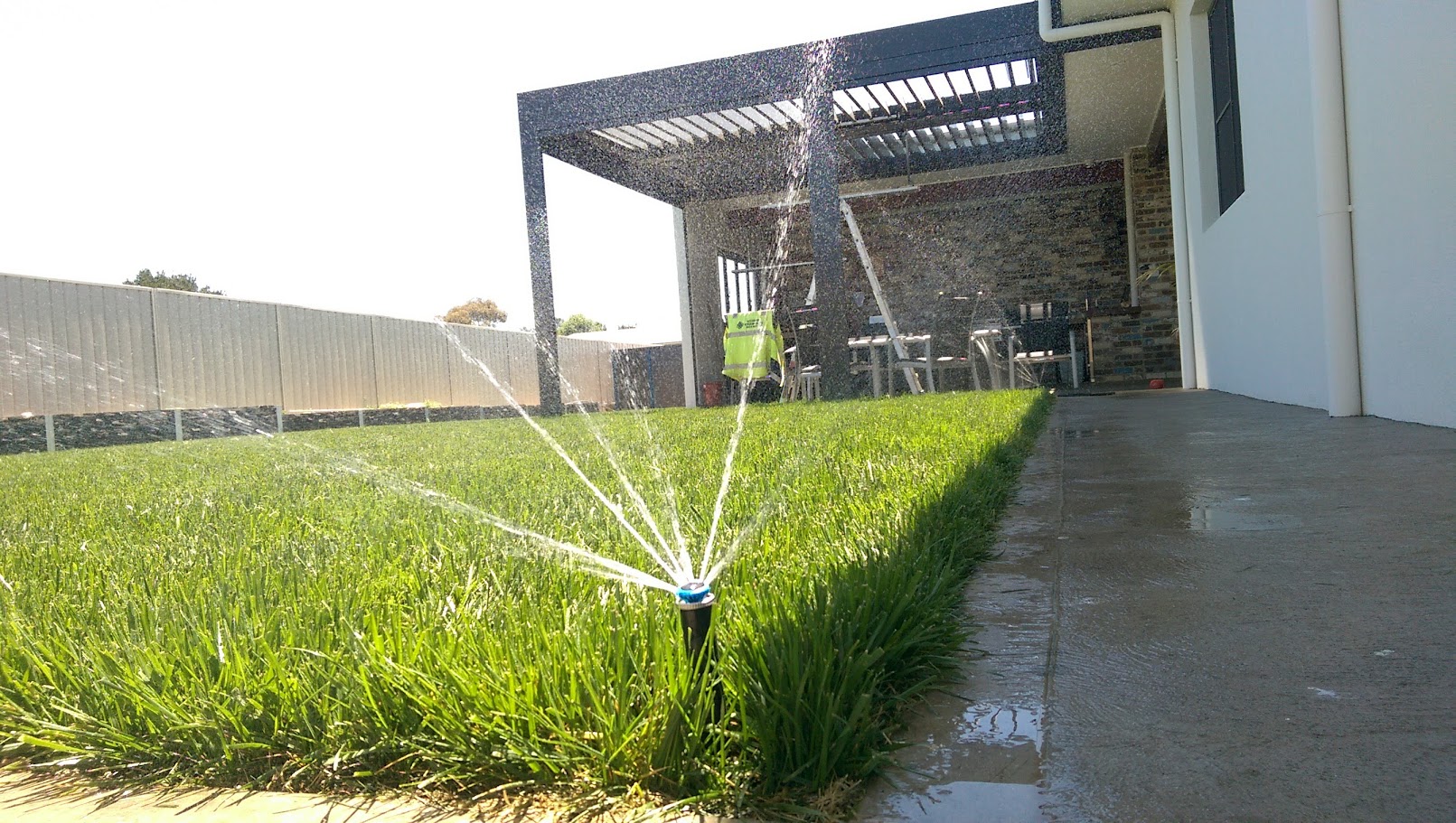
An in ground pop up sprinkler system with an irrigation timer is the easiest way to do this, and in the long term it is the most cost effective as well. A well designed system will give an even coverage and will get into the corners without overspray. You will find that it uses less water and that your lawn will be beautiful and easy to maintain.

5 Things that will make your house pump work better and last longer

Irrigear Goulburn
  1. Is your pump out of the weather? Moisture, heat and cold are not good for your pump. Build or buy a pump cover and make sure that the pipework is insulated to prevent freezing.
  2. Is your pump leaking? A leaking pump not only wastes water, it will eventually cause an untimely (and expensive) end. Water leaks can get into the motor and bearings and that never ends well.
  3. Is your pump noisier than usual? That’s not good. Failing bearings make a lot of noise and cause the pump to run hotter than usual. Damaged impellers are also noisy and will eventually grind to a standstill. If it doesn’t sound right, get it in for a checkup quick smart!
  4. Have insects taken over? One day they will take over the world, but first they want to take over your pump. Clean the wasps away from the cooling vanes on the pump motor, and spray with a surface insecticide to keep ants and earwigs out of the switches and controllers. A more extensive spray for spiders and wasps makes it nicer if you need a service visit too.
  5. Is your pump starting and stopping a lot? Like us, pumps have a finite number of starts, so don’t waste them. If your pump is starting up when it shouldn’t you may have a leak. If it starts and stops rapidly, your pressure tank may need attention. If it starts and stops all day every day, your foot valve or check valve may need replacing. If you are not sure give us a call and we will help you diagnose the problem. But don’t ignore it, your pump is aging quickly.